In this article...
 Accounting is an essential function in any business, providing a picture of a company’s financial health. Generic accounting software works well for retailers, service businesses, and product-based businesses, but is ineffective at capturing the data that matters most to construction companies. This is because construction finances are tracked on an individual project basis.
Alongside standard accounting functions, construction accounting must handle project-based costing, subcontractor payments, CIS compliance, retention, contract variations, work in progress (WIP), cash flow forecasting, and real-time project profitability. RedSky is software built specifically to handle the specialised accounting needs faced by construction businesses.
Construction accounting software vs regular accounting software: Key features and differences
| Generic accounting software | Construction accounting software |
| Tracks the company’s finances | Dual oversight of project-level and organisational financials. |
| General budgets | Comparing actual costs against baseline budgets per contract. |
| Standard invoicing | Track partial payments for retentions, manage payment applications, and calculate valuations. |
| Basic reporting | Job profitability, WIP, contract reporting |
| Payroll | Payroll, update contracts with accurate labour costs |
| Supplier invoices | Supplier invoices shown as costs against the contract in real time |
| Financial reports | Commercial and operational reporting |
| Subcontractor management, Construction Industry Scheme compliance |
What are the benefits of construction accounting software?
Dedicated construction accounting platforms integrate live contract costs, valuations, subcontractor balances, and retention tracking into a central accounting system.
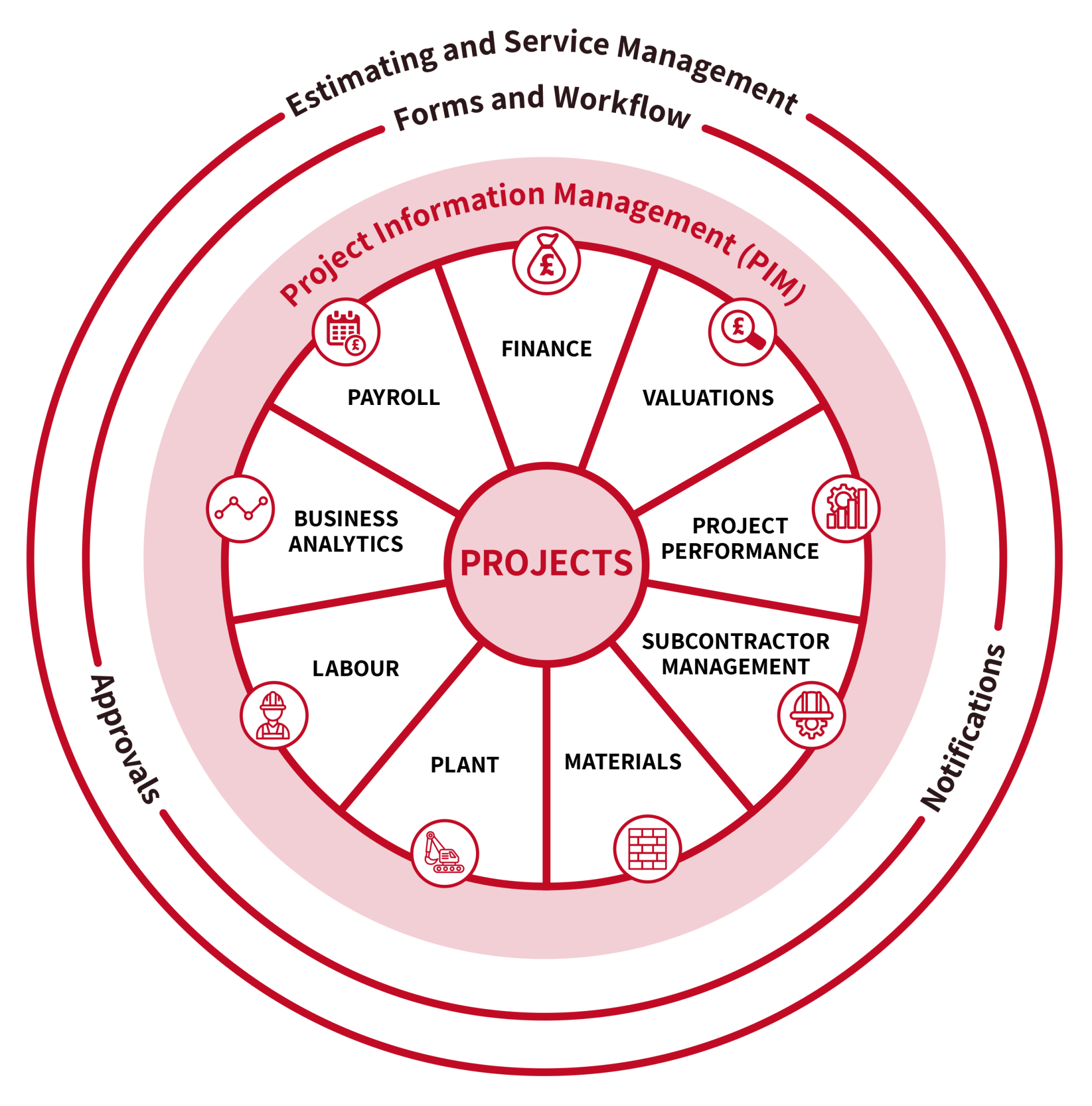
RedSky was built on this principle: track the financial data for each project and for the business as a whole, and make it accessible to the whole team. Leadership can then spot trends before they become issues and change course to improve project outcomes.
Job costing and real-time cost tracking
Every construction project has multiple cost centres, including labour, materials, plant, equipment, subcontractors, overheads, purchase orders and variations, and each can drift off budget in different ways. Job costing tracks these against their original estimates in real time rather than reconciling them after the fact, so project managers can identify potential overruns while there’s still time to fix them.
RedSky’s Cost Value Reconciliation (CVR) reporting provides commercial teams with real-time views of cost versus budget, enabling them to identify and remedy worrying trends as they arise.
CIS compliance and subcontractor management
 UK construction businesses face a substantial compliance challenge with the Construction Industry Scheme (CIS). They must accurately handle deductions, verify subcontractors, manage payment and deduction statements, and report to HMRC consistently for every subcontractor across all projects.
Managing these compliance matters using spreadsheets or generic accounting software increases the risk of costly errors. A missed verification, incorrect deductions or a late submission could trigger HMRC penalties and damage subcontractor relationships.
RedSky’s subcontractor and CIS management tools handle this process from beginning to end.
Managing retention and staged payments
In a standard accounting system, the process is: raise an invoice and eventually get paid in full. Construction works differently. In construction, payments are staged, conditional, and often delayed according to the contract.
Contractors submit applications for payment, which are assessed through interim valuations before a certified payment is agreed. A percentage of that payment, the retention, is withheld and released at the end of the liability periods. Mishandled retentions can leave money owed unclaimed or forgotten, and generic software has no mechanism for a payment that is partially due, conditionally certified, and partly withheld for a year or more.
While the government is moving toward a ban on cash retentions in construction contracts, RedSky ERP fully supports retention management and will comply with any new legislation accordingly.
Contract variations and change management
Few projects run exactly to the original scope. Client instructions change, additional work is requested and scope shifts. These variations must be tracked, priced, and agreed upon, whether approved or pending.
Construction accounting software reflects them directly in project cost and revenue forecasts, giving teams an accurate, up-to-date view of contract value.
Work in Progress (WIP) reporting and project profitability
Work in Progress (WIP) reporting brings together costs incurred, revenue recognised, earned value, and forecast margin to show a contract’s current position, rather than at completion. Standard accounting, which recognises revenue largely on invoicing, isn’t equipped for this. A project could be 60% complete but only 40% invoiced, or costs could be outpacing value earned.
The real value of WIP reporting is seeing when a project may become unprofitable while there’s still time to act.
Read more in The Importance of Work in Progress Reports in Construction.
Managing cash flow across complex project lifecycles
Cash flow management in construction involves balancing numerous moving parts, including supplier invoices, labour obligations, payment delays, withheld retentions, and overlapping project timelines, all while drawing on shared capital.
Generic accounting software forecasts cash flow largely by looking backwards from historical accounts and past invoicing patterns. That approach doesn’t work in construction, where a business might have five projects at five completely different stages, each with its own upcoming payment obligations, expected valuations, and retention release dates.
Managing multiple projects simultaneously
Construction businesses rarely work on just one project at a time. Leadership should be able to rely on their accounting software to compare performance across contracts, identify where resources are stretched, and drill down into which regions or business units are supporting the business, and which aren’t.
That means construction accounting software needs to provide company-wide dashboards alongside individual project details, plus regional and divisional reporting.
Contractors can rely on RedSky’s centralised visibility across every project, region and team, which allows leadership to see the full picture of the business alongside the fine detail of any individual contract.
Why does General Accounting Software Fall Short when it Comes to Construction?
Without specialised construction accounting software, you may experience the following limitations.
- Limited project costing. Standard platforms organise financial ledgers at the company level rather than mapping costs directly to individual project structures.
- Manual spreadsheets. Without job costing, WIP, CIS or retention tools, teams export, manipulate and re-import data manually, which is time-consuming and error-prone.
- Delayed reporting. If project financials don’t update in real time, problems may be discovered too late.
- No commercial visibility. Without live cost and value tracking, contract profitability is often hidden until the final numbers are in.
- Separate systems. Estimating, procurement and accounting often sit in disconnected systems, each with its own version of the numbers, reconciled manually after the event. With construction accounting software, costing, CIS, WIP, retention, and cash flow forecasting all run from the same data, so finance and commercial teams work from one shared version of the truth.
H2 What to Look for in Construction Accounting Software?
When evaluating construction accounting software, consider these features against your industry’s specific financial requirements. At a minimum, look for:
- Project-based ledgers and cost centres
 – Track cost and revenue by contract, with true margin visibility at the project level.
- Real-time job costing – Live tracking of all cost centres against budget.
- Built-in CIS compliance – Subcontractor verification, deduction calculation, statements, and HMRC reporting.
- Applications, valuations, and retention management – Payment applications, interim valuations, certified payments, and retention release schedules as standard workflows.
- Variation tracking linked to project finances – Approved and pending variations reflected directly in cost and revenue.
- WIP reporting – Costs incurred, revenue recognised, earned value, and forecast margin at any point in a contract.
- Cash flow visibility – Forecasts based on project schedules, payment applications, and retention release dates.
- Multi-project and multi-entity reporting – Dashboards comparing contracts, regions, and divisions from one data set. These should all draw from the same underlying financial data rather than functioning as separate modules that need reconciling.
Why Integrated Construction Software Delivers Greater Commercial Control
 Integrated construction software gives contractors greater commercial control by bringing every part of the business into a single, connected view. When project, financial, and operational data live in one system, decision-makers no longer wait for spreadsheets to be reconciled or reports to be compiled; they can act quickly using information they trust. That speed translates directly into profitability, as cost overruns, margin erosion, and cash flow pressures are spotted early and addressed before they escalate. By removing duplicate data entry and manual handovers between departments, teams spend less time on administration and more time on the work that drives value. Compliance becomes easier to maintain, with consistent processes, clear audit trails, and up-to-date records built into everyday workflows. And because reporting draws from a single source of truth, leaders gain an accurate, real-time picture of performance across every project, enabling smarter planning, stronger forecasting and a more resilient business overall.
These improvements come from removing the gaps between systems, which is what integrated construction accounting software like RedSky is built to do.